 en
en  cn
cn  it
it  es
es  tr
tr  ja
ja  sv
sv  pt
pt  nl
nl  ru
ru  fr
fr  de
de  pl
pl 
Serving global fashion brands
as the core supply chain of excellence, agility, and innovation.
as the core supply chain of excellence, agility, and innovation.
04 Aug 2026 / Industry
For many fashion brands, fabric sourcing begins as a purchasing decision. Teams compare suppliers, review swatches, negotiate prices and confirm delivery schedules before moving into sampling. While these activities are essential, they represent only one part of the process. In reality, the fabric selected during product development influences nearly every stage that follows, from pattern optimization and sewing efficiency to quality consistency and production lead time.
Experienced manufacturers rarely evaluate fabrics based on appearance or cost alone. They consider how a material behaves during cutting, stitching, pressing and finishing, whether it remains consistent across production batches, and how reliably it can support future collections. A fabric that performs well in a sample room may create unexpected challenges during bulk production if technical performance has not been evaluated early enough.
This is why leading fashion brands increasingly involve manufacturing partners before fabric decisions are finalized. Instead of treating fabric sourcing as a standalone procurement activity, they integrate it into product development, garment manufacturing and long-term supply chain planning. The result is not only better garments, but also fewer production interruptions, more predictable quality and greater flexibility throughout the sourcing process.
Several years ago, many apparel brands focused primarily on finding fabrics that met design expectations at competitive prices. Today, the criteria are much broader. Product life cycles are shorter, consumer demand changes faster and sourcing teams are expected to deliver both flexibility and resilience. As a result, fabric sourcing has become closely connected with product development, manufacturing performance and supply chain strategy.
One reason for this shift is the increasing complexity of garment production. A single outerwear collection may include recycled fabrics, functional coatings, technical linings and specialty trims sourced from different suppliers and regions. Every additional material introduces another variable that can affect production planning, quality consistency and delivery reliability. Choosing the right supplier is no longer enough; brands also need to understand how different materials interact throughout the manufacturing process.
Another important change is the growing emphasis on repeatability. Fashion brands are no longer evaluating fabrics only for one season. They are looking for suppliers capable of supporting repeat orders, regional production transfers and future product updates without compromising quality. This requires a sourcing strategy that considers long-term stability rather than short-term purchasing advantages.
For manufacturers, this means sourcing decisions begin much earlier than many people assume. Before recommending a fabric, development teams often review its technical performance, production compatibility and availability across different manufacturing locations. A fabric that looks impressive in a showroom but performs poorly during sewing or finishing rarely delivers commercial success.
Price remains an important factor, but experienced sourcing teams understand that the lowest material cost does not always produce the lowest manufacturing cost.
A fabric that requires additional sewing operations, generates excessive waste during cutting or increases quality inspection failures may ultimately cost far more than a slightly higher-priced alternative. Likewise, inconsistent fabric quality between production lots can result in delays, rework and customer claims that significantly exceed any initial savings.
Successful apparel sourcing therefore focuses on total manufacturing value rather than purchase price alone. Material decisions should support both product performance and production efficiency throughout the entire garment lifecycle.
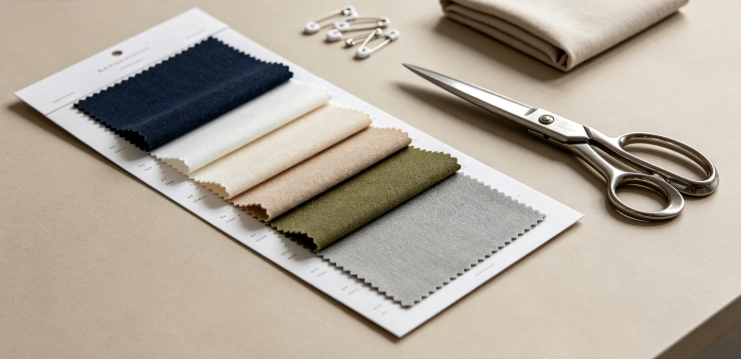
Once a fabric enters production, its characteristics influence nearly every manufacturing operation. Many quality issues commonly associated with factory workmanship actually originate from material behavior that was not fully evaluated during development.
This is particularly true for woven garments. The same construction method may produce excellent results with one fabric but require substantial adjustments when another material is introduced. Differences in yarn composition, fabric density, coating or finishing can affect cutting accuracy, seam appearance, pressing performance and dimensional stability.
Rather than viewing fabric sourcing and garment manufacturing as separate activities, experienced manufacturers evaluate how each material performs under actual production conditions.
The cutting room is often where material consistency is first tested. Variations in fabric width, shrinkage or surface stability can reduce marker efficiency and increase material waste. Even small inconsistencies become significant when thousands of garments are produced from the same fabric lot.
Stable fabrics improve cutting precision and help ensure that garment panels remain consistent throughout production. This contributes directly to better fit, smoother assembly and reduced quality variation.
Different fabrics respond differently to sewing operations. Some materials maintain seam stability with minimal adjustment, while others require specialized needles, thread selection or machine settings to achieve acceptable results.
Factories that participate in fabric sourcing discussions early can evaluate these factors before production begins. Instead of solving problems after sewing has started, they can recommend material adjustments or construction refinements during development.
Pressing is one of the final opportunities to achieve the desired garment appearance, yet it is also one of the stages most affected by fabric characteristics.
Heat sensitivity, dimensional stability and recovery all influence how a garment responds during finishing. If these properties are overlooked during development, production teams may encounter puckering, distortion or inconsistent appearance despite following correct manufacturing procedures.
This is why material evaluation extends well beyond laboratory specifications. Factory trials often reveal practical performance differences that technical data alone cannot predict.
| Fabric Characteristic | Potential Manufacturing Impact |
|---|---|
| Fabric weight | Cutting efficiency and garment structure |
| Stretch stability | Sewing consistency and seam quality |
| Surface finish | Pressing performance and appearance |
| Shrinkage behavior | Size accuracy after finishing |
| Batch consistency | Production stability and quality control |
The objective is not to find a universally "better" fabric, but to identify the material that best supports the intended garment, manufacturing process and customer expectations.
One of the biggest misconceptions about fabric sourcing is that quality evaluation starts after purchase orders have been placed. Inside experienced garment factories, the opposite is true. Technical assessment often begins before fabrics are officially approved for sampling.
Development engineers understand that changing materials after patterns, sewing methods and production planning have already been completed creates unnecessary delays. Instead, they work alongside sourcing specialists to identify potential risks while there is still enough flexibility to make improvements.
For woven outerwear, for example, development teams frequently conduct internal assessments before recommending a fabric for bulk production. These evaluations do not replace laboratory testing; they complement it by examining how the material behaves under real manufacturing conditions.
Typical assessments include:
These practical evaluations often identify issues that cannot be detected from specification sheets alone. A fabric may satisfy all required technical parameters yet still create unnecessary production complexity because of its behavior on the factory floor.
Another important consideration is production repeatability. Sampling usually involves experienced technicians working on individual garments. Bulk manufacturing is entirely different. Hundreds of operators must reproduce the same construction consistently over thousands of pieces. Materials that perform well during sampling but lack stability during continuous production often become sources of quality variation.
This manufacturing perspective explains why experienced suppliers rarely separate material selection, technical development and production planning. Each decision influences the next, and optimizing them together creates a more reliable production process.