 en
 cn
 it
 es
 tr
 ja
 sv
 pt
 nl
 ru
 fr
 de
 pl

Serving global fashion brands
as the core supply chain of excellence, agility, and innovation.
27 Nov 2026 / Industry
Clothing sampling costs depend on the sample stage, garment specifications, and the work included in the supplier's quotation. A basic fitting sample using an established pattern requires different work from a new jacket that needs pattern development, material sourcing, and several construction details.
The quoted price may include pattern development, sample making, materials, trims, decoration, revisions, and shipping. Some suppliers combine these costs, while others charge for each item separately. Comparing only the headline sample price can therefore be misleading.
A quotation should distinguish one-time development costs from charges that apply per sample or revision round.
Quotation item | What to confirm | Possible charging basis |
Sample type and quantity | Development, fitting, sales, or pre-production sample; number of pieces | Per piece or round |
Pattern development | New pattern or pattern adjustment | Per style or development scope |
Sample making | Work included in producing the sample | Per piece or round |
Fabric and trims | Included, supplied by the brand, or charged separately | Included or actual cost |
Printing and embroidery | Setup and processing requirements | Setup fee plus per-piece charge |
Included revisions | Number and scope of included changes | Included within the quoted round |
Additional revisions | How extra work is approved and charged | Per round or agreed work scope |
Shipping | Number of shipments and destination | Per shipment |
Bulk-order credit | Eligible fees, minimum order conditions, and timing | Subject to agreed conditions |
Each item should be identified as included, separately charged, or pending confirmation. An unspecified cost should not be assumed to be free.
The completeness of the technical information also affects the quotation. Missing measurements, fabric details, or construction instructions may require additional clarification. A clear apparel tech pack gives the supplier a defined basis for development.
Consider two hypothetical quotations for the same woven jacket, using identical specifications, materials, sample quantity, and first-round service scope.
Quotation A:
Cost item | Hypothetical amount |
Pattern development | 100 |
Sample making | 60 |
Materials | 30 |
Courier | 20 |
First-round total | 210 |
The first-round cost is 210 hypothetical currency units.
After reviewing the sample, the brand requests one additional revision. The supplier quotes 40 units for the extra work. No additional courier shipment is required in this example.
Quotation A total after revision: 210 + 40 = 250 units.
Quotation B:
The supplier initially quotes 100 units, covering sample making and materials. Pattern development and courier charges are billed separately:
Cost item | Hypothetical amount |
Sample making and materials | 100 |
Pattern development | 100 |
Courier | 20 |
First-round total | 220 |
Under the same first-round scope, Quotation B totals 220 units, compared with 210 units for Quotation A. Although B has a lower initial quoted amount, its complete first-round cost is higher after the excluded items are included.
If the comparison extends to additional revisions, the revision charges and any extra courier costs must also be added according to each supplier's quotation.
These figures are illustrative only. They are not market price benchmarks or a KINGSRICH quotation.
A development sample explores an initial design or construction approach. A fitting sample focuses on measurements and fit. A sales sample represents the intended product, while a pre-production sample confirms the specifications to be followed in bulk manufacturing.
Garment construction also affects the workload. A woven jacket with multiple panels, lining, interlining, pockets, and functional closures generally requires more pattern and sample work than a basic shirt. Special fabrics, custom trims, printing, and embroidery may add material sourcing or setup costs.
The number of changes during development matters as well. A sample that requires substantial changes to fit, pattern, or construction may need another round of work. Brands should therefore confirm which sample stage they are ordering and what level of development is included.
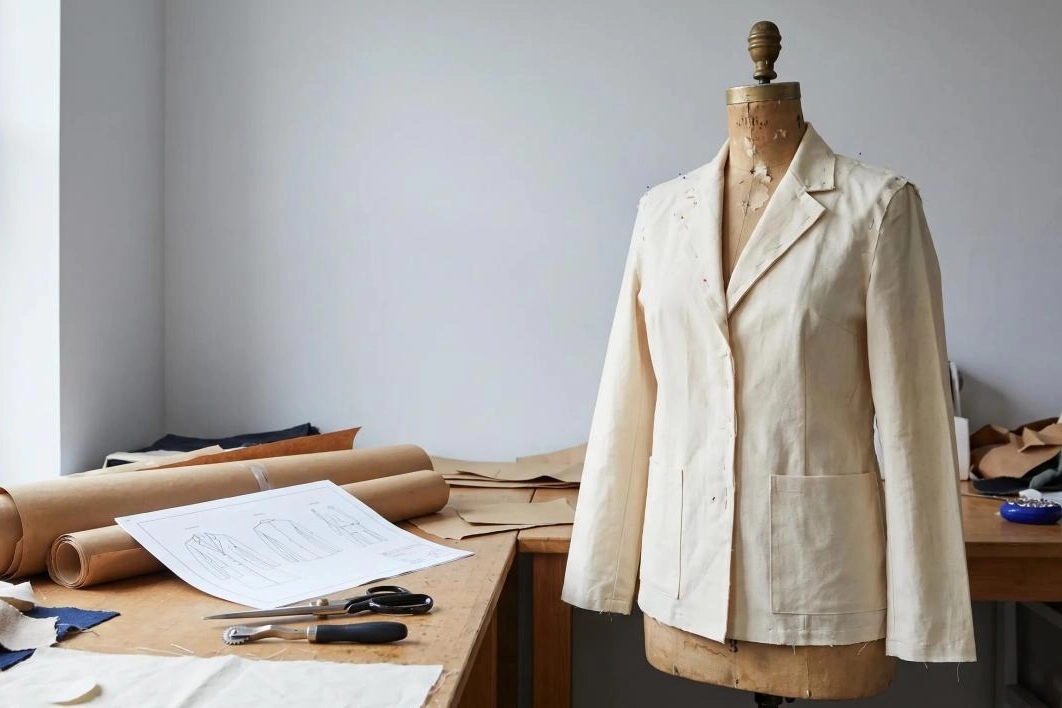
A jacket sample during development
Correcting a sample that does not meet the approved specification is different from changing the specification at the brand's request.
If a sample does not follow the agreed measurements or construction details, the parties should clarify how the correction will be handled. If the brand later changes the pocket design, fabric, fit, or closure, the request may involve additional pattern work, material sourcing, or another sample round.
The quotation should state how these situations are charged. Additional work may be priced per revision round or according to the work required. Courier costs should also be confirmed if a revised physical sample needs to be shipped.
A revision record should identify the requested change, its reason, the affected specification, additional work, and the agreed charge before the supplier proceeds.
Some suppliers may offer to credit eligible sampling fees against a later bulk order. This should be treated separately from the initial sampling payment.
Before accepting the arrangement, confirm:
l Which fees qualify, such as sample making or pattern development.
l Whether a minimum order quantity or order value applies.
l Whether the credit is limited to the same style.
l When the credit is applied and whether it expires.
In Quotation A, the initial payment remains 210 units. If the parties agree that part of this fee can be credited against a qualifying bulk order, the credit only applies when the stated conditions are met.
A fair comparison uses the same sample stage, quantity, material and trim specifications, construction details, decoration requirements, revision allowance, and shipping scope.
The comparison should also consider what happens after sample approval. Measurements, construction, and materials must be carried into bulk production. A documented garment sample approval process provides a reference for confirming the approved version before production begins.
Sampling is a development expense, but its purpose is to resolve product and construction issues before bulk manufacturing. The most useful quotation is one that clearly defines the work required to reach an approved sample, not simply the one with the lowest initial price.