 en
en  cn
cn  it
it  es
es  tr
tr  ja
ja  sv
sv  pt
pt  nl
nl  ru
ru  fr
fr  de
de  pl
pl 
Serving global fashion brands
as the core supply chain of excellence, agility, and innovation.
as the core supply chain of excellence, agility, and innovation.
12 Aug 2026 / Industry
A fashion sketch can show what a garment should look like, but it rarely gives a manufacturer enough information to make the product accurately. Before a sample can be developed, the factory needs to understand the intended measurements, materials, construction and finishing requirements.
This is where an apparel tech pack becomes useful. From a manufacturer's perspective, a tech pack is not simply a design document. It is a working reference that helps the development team interpret the product and turn design information into a garment that can be sampled and eventually manufactured.
The quality of the technical information also affects communication. If measurements are unclear, materials are not fully identified or construction details are open to interpretation, additional questions and sample revisions are likely to follow.
A fashion sketch is useful at the beginning of product development because it communicates the overall visual direction of a garment. It can show the silhouette, proportions, color and major design features.
However, a sketch usually cannot tell a manufacturer exactly how the garment should be developed. It may show a pocket, for example, without specifying its dimensions, placement, construction or opening method. A collar may be clearly visible but still require additional information about its finished measurements and construction.
For a manufacturer, the missing information is often what determines whether a sample can be developed accurately.
An effective tech pack fills this gap by translating design intent into technical information that can be used during sample development, pattern development and production preparation. It gives the manufacturer a clearer reference before physical development begins and provides a common basis for communication when changes are required.
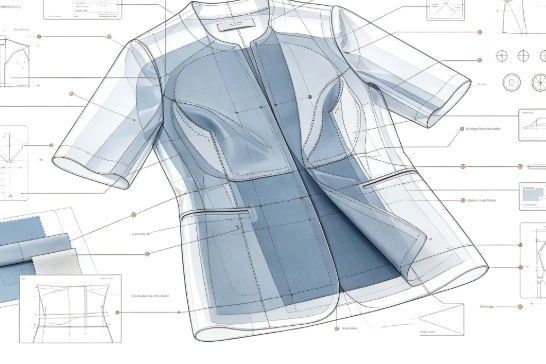
Technical drawings or technical flats are also important because they provide a clearer representation of garment details than a fashion sketch alone. They can show pocket placement, seam lines, closures, panel divisions and other construction or design features that need to be interpreted consistently during development.
Before sample development begins, the manufacturer needs to establish several basic areas of information. The exact content varies by garment, but most projects require clear information covering the product, fit, materials and construction.
· Product identification: style number, product name and current version, together with technical drawings or flats where they are needed to clarify the garment.
· Fit requirements: finished measurements, size range and acceptable tolerances.
· Material requirements: main fabric, lining, interlining, trims and other specified materials.
· Construction requirements: seams, pockets, collars, cuffs, closures and other important garment details.
Material requirements may also be organized through a bill of materials (BOM) or material specification, identifying the fabrics, linings, interlinings, trims and other components required for development and production. This gives the manufacturer a clearer reference when materials need to be sourced, reviewed or confirmed.
These areas are connected. A change in fabric can affect garment measurements and construction. A change in fit may require pattern adjustments. A change in construction can influence both appearance and production efficiency.
A manufacturing-oriented tech pack therefore needs to give the development team enough information to understand these relationships before making the sample.
Measurements are among the most important parts of a tech pack because they provide an objective reference for fit and pattern development.
A manufacturer needs to know where each measurement is taken, what the finished measurement should be and how much variation is acceptable. Simply providing a general size chart may not be enough to develop a specific garment accurately.
Important information can include points of measurement, finished measurements, tolerances, size grading and changes between sample revisions. For example, body length, chest, shoulder and sleeve measurements can all affect the overall balance of a garment. A small change in one area may also require adjustments elsewhere in the pattern.
Clear measurement specifications give the manufacturer a reference for apparel pattern development and garment fit development. They also make sample reviews more objective because changes can be discussed against defined measurements rather than relying only on visual judgment.
This becomes particularly important when a sample goes through several revisions. If the latest measurement changes are not clearly recorded, the development team may work from outdated information.
The fabric specified in a tech pack is not just a material name. Its characteristics can influence how the garment is patterned, constructed and finished.
Weight, structure, hand feel, surface appearance and dimensional stability can all affect the final result. A pattern developed for one fabric may not produce exactly the same appearance when a different material is substituted, even if the two fabrics look similar.
This is particularly relevant to woven garments. A lightweight woven fabric may require different handling during sewing and pressing from a heavier structured material. Outerwear can introduce additional considerations when linings, interlinings and multiple fabric components are involved.
For this reason, a useful manufacturing tech pack should provide enough information for the manufacturer to identify the intended material and understand its role in sample development. When the final bulk fabric differs from the sample material, the development team may also need to reassess fit, construction or finishing before production moves forward.
A manufacturer also needs to understand how the garment is supposed to be assembled. A technical drawing or image may show the appearance of a garment, but it does not always communicate the exact construction required to achieve that appearance.
Construction information may cover seam methods, stitching, pocket construction, collar and cuff details, hems, closures, interlining and finishing requirements.
For woven garments, these details can have a direct effect on the finished appearance. A pocket placed slightly differently can change the visual balance of a shirt or jacket. The wrong seam treatment can affect how a structured garment holds its shape. Finishing methods can also influence the final appearance after pressing.
The purpose is not to make the tech pack unnecessarily complicated. The information should be specific where interpretation could lead to a different result.
For a manufacturer, clear construction instructions reduce uncertainty during technical garment development and make it easier to identify questions before a sample is produced rather than after a sample has already been completed.
A tech pack is rarely a completely static document. Changes are common during sample development as the brand and manufacturer review the garment together.
Measurements may be adjusted after a fitting. A fabric may change because of availability or performance requirements. Construction details may be refined after reviewing the sample. Trims can also be replaced or modified.
The important issue is making sure that these changes are recorded and that the manufacturer can clearly identify the current version.
A simple version number or revision date can prevent confusion, but the changes themselves should also be clear. If a sleeve measurement has changed, for example, the updated specification needs to be distinguishable from the previous one. The same applies to fabric, construction and other technical requirements.
Using outdated information can lead to another sample being developed against the wrong specifications or create discrepancies between the approved requirements and production. Good revision control is therefore part of production preparation, not just document management.
A tech pack does not need to contain every possible piece of information before a manufacturer can review it. What matters is whether the available information is accurate and sufficient for the next stage of development.
Before sending a tech pack to a manufacturer, brands should be able to answer a few practical questions:
· Can the manufacturer understand the intended fit?
· Are the main materials clearly identified?
· Are measurements and tolerances available?
· Are important construction details clear?
· Are the latest revisions included?
· Is there enough information to begin sample development?
If several of these questions cannot be answered, the manufacturer may need to make assumptions or request additional information before development can proceed.
A well-prepared tech pack gives both sides a clearer starting point. It allows the manufacturer to assess the garment from a production perspective while giving the brand a consistent technical reference for sample review and subsequent manufacturing.
At Kingsrich, garment development is closely connected with manufacturing and supply chain coordination, helping technical information move more smoothly from sample development into production.
An apparel tech pack is a technical reference used to communicate the information a manufacturer needs to develop a garment. Depending on the product, it can include measurements, materials, technical drawings, construction details, specifications, revisions and other production requirements.
The content depends on the garment, but it generally needs clear information about the product, fit, materials and construction. Measurements, tolerances, technical flats, fabric specifications, a BOM, trims and important construction details may all be required for sample development.
Measurements provide a defined reference for pattern development and fit evaluation. They also make it easier for the brand and manufacturer to identify and communicate changes during sample revisions.
Sometimes a manufacturer can begin development with limited information, but missing technical details may lead to additional questions, assumptions or sample revisions. The more complete and current the production information is, the clearer the starting point for sample development.