 en
en  cn
cn  it
it  es
es  tr
tr  ja
ja  sv
sv  pt
pt  nl
nl  ru
ru  fr
fr  de
de  pl
pl 
Serving global fashion brands
as the core supply chain of excellence, agility, and innovation.
as the core supply chain of excellence, agility, and innovation.
03 Mar 2026 / Industry
Two apparel orders can have almost the same quantity and still have very different delivery schedules.
One order may have complete product information, approved specifications, materials ready and a production slot already available. Another may still be waiting for a missing component, clarification on a construction detail, or space in a production schedule that is already committed to other orders.
The difference is not necessarily the amount of sewing required.
The factors that determine apparel manufacturing lead time begin well before the first garment reaches the production line. Product information, material readiness, production capacity and scheduling conditions can all affect when bulk manufacturing can realistically begin.
For manufacturers, production planning is therefore more than putting dates on a calendar. It requires an understanding of what is ready, what still needs to be prepared and how the order fits within the available production capacity.
When a brand receives a lead-time estimate, it is easy to focus on the number of production days. In practice, those days represent only part of the timeline.
Before an order can enter bulk manufacturing, the factory needs a workable basis for production. Product information has to be sufficiently clear, required materials need to be available at the appropriate stage, and the order needs to fit within the manufacturer's existing production schedule.
A factory may have substantial overall capacity but no realistic opening for a particular order in the immediate future. Similarly, a production line may be capable of making the garments but unable to begin because an important component is still unavailable.
This is why garment production lead time should not be treated as simply the time spent sewing garments.
The conditions established before production starts can influence the date on which manufacturing can actually begin. Once production is underway, the way capacity is managed and how unexpected changes are handled can affect the remaining schedule.
For brands, this provides a more realistic way to understand why two apparently similar orders can receive different lead-time estimates.
Production planning becomes difficult when the requirements for an order are still changing.
Before a manufacturer can confidently organize production, the production team needs enough information to understand what has to be made. Depending on the garment, this may include final specifications, approved measurements, construction details, size requirements, material specifications and relevant packaging or labeling requirements.
The purpose here is not to revisit the product development process. It is much more practical: the manufacturer needs a sufficiently stable production basis before the work can be planned accurately.
For example, if a construction detail remains undecided, production instructions may need to be revised later. If measurements change after preparation has begun, some production information or preparation work may also need to be adjusted.
These changes can consume time even before the order reaches the sewing line.
A useful distinction is that product information defines what needs to be produced, while production planning determines how the available manufacturing resources can be organized around that requirement.
Once the requirements are sufficiently stable, the manufacturer has a clearer basis for estimating the work involved, allocating resources and establishing a realistic production schedule.
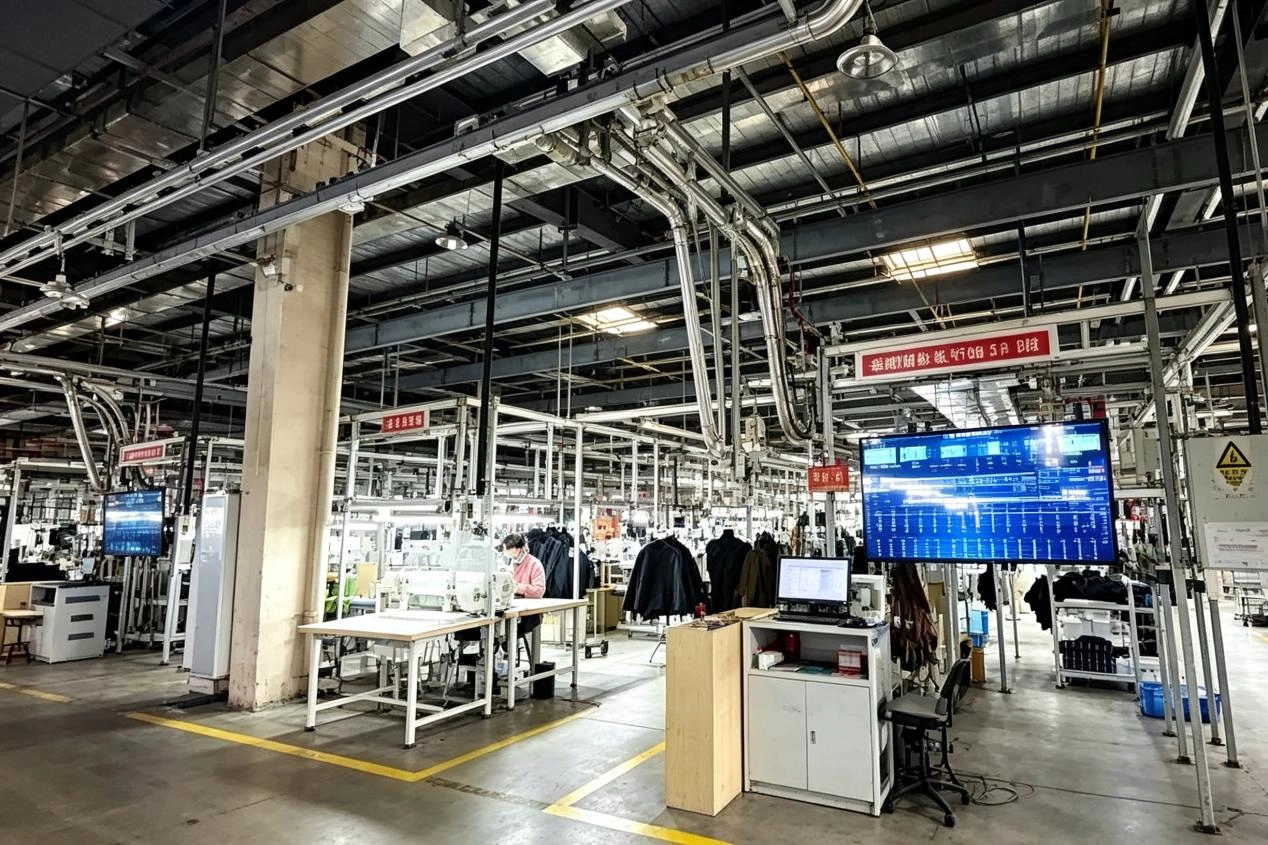
A production schedule is only realistic when the materials required for the planned work are ready.
Depending on the garment, an order may involve the main fabric, lining or interlining, trims, closures, labels and packaging materials. These items do not necessarily need to arrive at the factory at exactly the same time, but the components required for a particular production stage need to be available when they are needed.
A factory may reserve production capacity for an order and prepare for its planned start, but a missing critical component can still prevent production from moving forward as expected.
This is particularly important because not every material delay has the same effect. If an outstanding component is unrelated to the work scheduled for the first stage, some preparation may be able to continue. If the missing item is essential to the planned production activity, however, the start date may need to move.
The relationship is straightforward:
Production capacity cannot compensate for missing production materials.
This is why garment production planning needs to take material readiness into account rather than treating production capacity and material availability as separate issues.
The question is not simply whether materials have been ordered. What matters for planning is whether the materials needed for the relevant production activities are ready when those activities are scheduled.
A manufacturer may have sufficient overall capacity without having immediate capacity for a particular order.
Existing commitments, production priorities and previously scheduled work all influence when a new order can realistically be accommodated. The characteristics of the garment can also affect how the order fits into available production resources.
Production planning may therefore need to consider:
· Existing production commitments
· Available capacity during the required period
· Appropriate production resources
· Style complexity and production requirements
· Required delivery date
The key distinction is between available capacity and immediately available capacity for a specific order.
For example, a manufacturer could have enough total capacity to produce an order during a particular month, while the earlier part of that month is already committed to other production. The order may therefore have to be scheduled for a later opening rather than starting immediately.
This is one reason why asking only, "How many days does production take?" may not provide a complete picture of production scheduling.
The estimated manufacturing period depends partly on when the order can enter the planned schedule and how it fits with other production commitments.
For brands, this distinction can help explain why a manufacturer's quoted lead time may differ from a simple calculation based on the number of garments.
Once an order has been considered for production, preparation still needs to support the planned start.
Production information, cutting requirements, work instructions and quality requirements may need to be organized before bulk manufacturing begins. The exact preparation depends on the garment and the manufacturer's working methods, so it should not be assumed that every factory handles this stage in exactly the same way.
The underlying purpose is more consistent: the people involved in production need a clear understanding of the approved requirements.
Poor preparation can create delays later.
A construction detail that remains unclear may require additional clarification. An overlooked requirement may need to be incorporated after preparation has already started. If a change affects several connected production activities, the resulting adjustment can take more time than the original issue suggests.
This is why preparation should be considered when evaluating garment manufacturing lead time.
A production schedule is more reliable when the work required before line production has already been accounted for. The more uncertainty remains at the point when bulk manufacturing is expected to begin, the greater the risk that the original schedule will need adjustment.
Order quantity is an important planning variable, but it does not provide a simple formula for manufacturing lead time.
A smaller order still requires certain preparation activities, material handling and production arrangements. These requirements do not disappear simply because fewer garments are involved.
A larger order generally requires more total production capacity, while some preparation and setup work can be distributed across a greater number of garments once production is running steadily..
The structure of the order matters as well.
An order consisting of one style in a straightforward size and color assortment may be easier to schedule than the same total quantity divided across numerous variations. Changes between different configurations can affect how production resources are allocated and how the order fits alongside other scheduled work.
The main planning considerations can include:
Order characteristic | Possible planning consideration |
Smaller total quantity | Preparation and setup can represent a larger share of the overall order |
Larger total quantity | More production capacity and time may need to be reserved |
Multiple colors or size combinations | Production allocation may require more detailed scheduling |
Multiple variations within one order | Production sequencing may become more complex |
This does not mean that larger orders always take longer or that smaller orders are always faster.
The relationship between quantity and bulk production lead time depends on the garment, order structure, available capacity and how the production work can be scheduled.
For this reason, total unit count should be considered alongside the actual composition of the order.
Even a carefully prepared production schedule can change after an order has been planned.
The effect depends heavily on what changes and when the change occurs.
A specification adjustment made before bulk preparation may give the manufacturer more room to update production information and adjust the schedule. The same change after cutting or sewing has already started can have a broader effect because work may already have been completed based on the previous requirements.
Examples of changes that can affect an existing schedule include:
· Changes to approved specifications
· Material substitutions
· Construction adjustments
· Additional approval requirements
· Rework caused by production issues
Not every change creates a major delay. Some can be absorbed into existing production arrangements, while others require activities to be repeated or rescheduled.
Timing is therefore critical.
The earlier a production change is identified, the more options the manufacturer has to adjust the schedule without disrupting ongoing production.
This is particularly relevant to apparel production planning because a production schedule is based on the conditions known when the plan is established. When those conditions change, the schedule may need to change as well.
For a bulk order, the impact can become greater as production progresses. A change made before preparation is different from a change after materials have been cut or garments have already entered production.
For brands, a realistic lead-time discussion should involve more than asking how many days a manufacturer needs to produce an order.
A useful discussion should establish whether the conditions behind the proposed schedule are actually in place.
Before confirming a delivery expectation, brands can consider several practical questions:
· Is the product information sufficiently finalized?
· Are the required production materials ready?
· Has the necessary production capacity been allocated?
· Is pre-production preparation complete?
· Does the schedule reflect the actual order quantity and assortment?
· Are there pending decisions that could change the production plan?
These questions do not guarantee that every order will follow the original schedule. Production conditions can change, and unexpected issues can still occur.
They do, however, make an estimated apparel manufacturing lead time more meaningful because the number is connected to actual production conditions rather than an idealized calculation based only on sewing time.
A capable manufacturing partner should be able to discuss lead times in the context of production readiness, available capacity and the requirements of the order rather than treating every project as if it follows the same schedule.
For brands, this also makes it easier to distinguish between a theoretical production time and a realistic delivery expectation.
Production planning affects when an order can enter manufacturing, how available capacity is allocated and how preparation work is organized. Product readiness, material availability, order quantity and production changes can all influence the final lead time.
Incomplete product information, unavailable materials, unresolved production requirements and limited production capacity can all delay a planned production start. Changes made close to or after the production start can create additional schedule pressure.
Yes, but not in a simple linear way. Quantity affects production scheduling, capacity allocation, preparation and total production time. The actual impact also depends on the garment style, assortment, production requirements and available capacity.
Clear product information, timely approvals, material readiness and realistic delivery requirements give a manufacturer a stronger basis for planning. Early communication about potential changes also gives the production team more options to adjust the schedule without unnecessarily disrupting bulk manufacturing.