 en
en  cn
cn  it
it  es
es  tr
tr  ja
ja  sv
sv  pt
pt  nl
nl  ru
ru  fr
fr  de
de  pl
pl 
Serving global fashion brands
as the core supply chain of excellence, agility, and innovation.
as the core supply chain of excellence, agility, and innovation.
20 Mar 2026 / Industry
Two garment factories can have similar equipment, similar production targets, and operators with comparable experience, yet one can consistently deliver more output with fewer delays and less rework.
The difference is rarely explained by sewing speed alone.
In a well-organized garment manufacturing process, materials arrive when they are needed, operators know exactly what is required at each stage, production tasks are distributed according to actual workloads, and quality issues are identified before they spread through a large batch. When these conditions work together, garments move through production with fewer interruptions.
By contrast, small problems can quickly become capacity losses. Common sources of lost production time include:
l Waiting for missing materials or components
l Bottlenecks between operations with different workloads
l Repeated handling, searching, or movement of unfinished garments
l Rework caused by defects discovered after production has progressed
For this reason, garment production efficiency is better understood as the performance of the entire production flow rather than the speed of any single operation.
Sewing is one of the most visible activities in garment production, but it is only one part of the process.
A sewing operator may complete an operation quickly, yet the overall line can still perform poorly if cut panels are not ready, components are mixed between orders, another operation becomes a bottleneck, or finished pieces repeatedly return for correction.
From a factory-floor perspective, efficiency is largely about keeping work moving.
The production team needs to coordinate materials, operators, equipment, instructions, and quality requirements so that one operation can hand work to the next without unnecessary waiting or handling.
This is why two production lines making similar garments can achieve very different results. One may spend most of the working day producing, while the other loses small amounts of time searching for components, waiting for work from another operation, adjusting processes, or correcting defects.
Those interruptions may only last a few minutes at a time, but when they occur repeatedly across a production line, the accumulated loss can become significant.
Before bulk production begins, the factory needs a clear and workable production basis.
This includes approved specifications, production instructions, cutting preparation, operation requirements, machine arrangements, and other information needed by the production team. The exact preparation varies by garment and manufacturing setup, but the purpose remains the same: production should not have to guess what needs to be made or how it should be handled.
A production line cannot operate efficiently when important information is still being clarified after work has started.
For example, if an operator receives incomplete construction instructions, the issue may first appear as a simple question. But if the answer affects several connected operations, the result can be interrupted work, changed instructions, or repeated pieces.
Good preparation reduces these interruptions before they reach the line.
This is an important part of manufacturing efficiency because production time can be lost before the first garment is sewn. Preparation is not separate from manufacturing performance; it establishes the conditions under which the production process will operate.
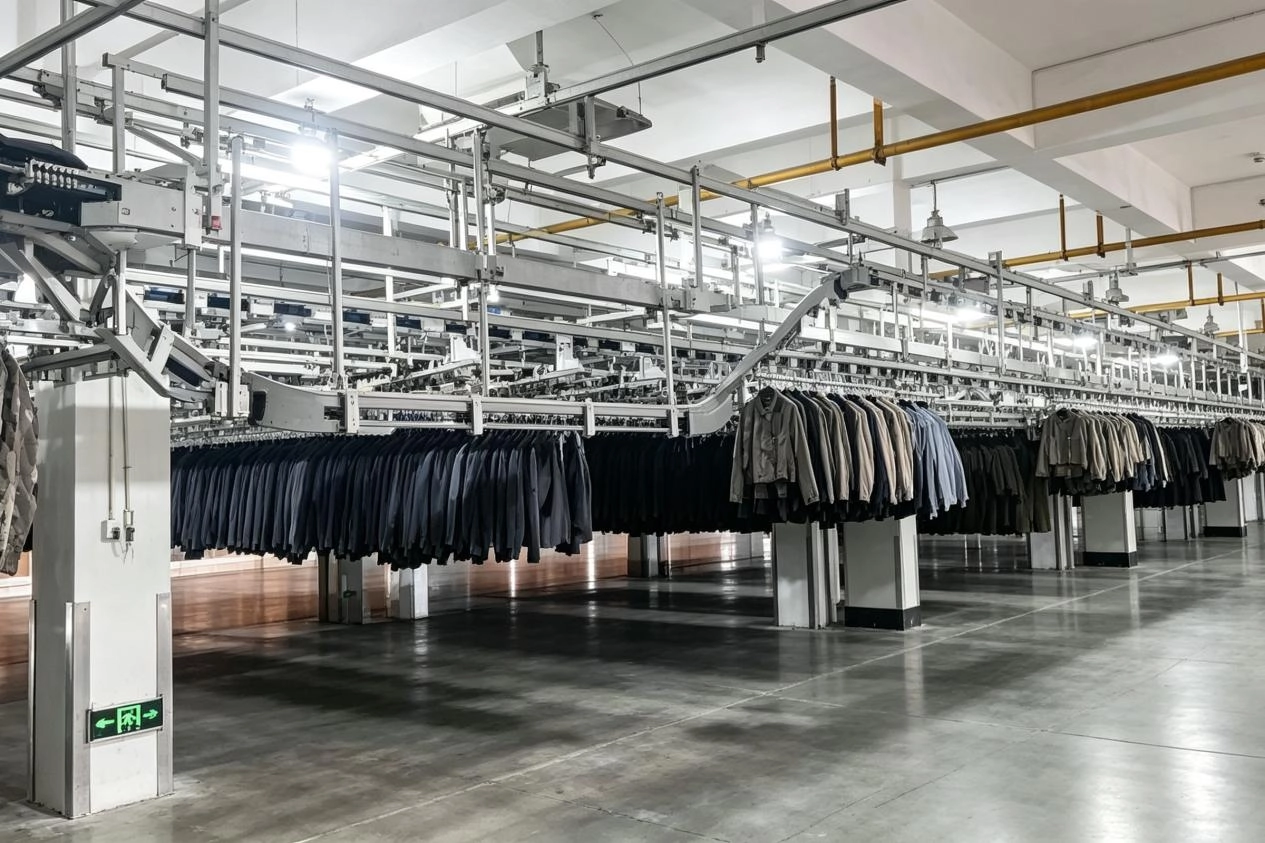
Production preparation answers the question of whether the work is ready to begin. Material readiness answers a different question: are the required components actually available when each operation needs them?
Cut panels, lining, interlining, trims, closures, labels, and other components need to be properly prepared and grouped for production. Depending on the garment, some components may also require additional preparation before reaching the sewing line.
A production schedule may show that a line is ready to start, but a missing component can make that planned start unrealistic.
The problem is not limited to major shortages. Small missing items can interrupt production just as effectively. If operators repeatedly stop to wait for a particular component or if bundles need to be separated and reorganized, available labor and equipment are no longer being used continuously.
Material readiness therefore has a direct relationship with garment production efficiency. The objective is not simply to have all materials somewhere inside the factory. They need to be available in the right form, in the right quantity, and at the right stage of production.
Once preparation and materials are ready, the way work moves through the factory becomes another major factor.
A simplified garment production flow may include:
Cutting → Component Preparation → Sewing Operations → Assembly → Finishing → Inspection
The exact sequence depends on the product and factory setup. What matters is whether the actual movement of work supports continuous production.
Unnecessary handling is often easy to overlook because no single movement appears particularly wasteful. A bundle may be moved to another workstation, returned for clarification, separated because components were mixed, and moved again before the operation is completed.
Repeated across hundreds or thousands of garments, those movements consume labor without adding value to the finished product.
The same applies to searching and waiting. If operators frequently need to look for the next bundle, wait for work from another operation, or move unfinished garments between distant workstations, the production line becomes less efficient even though every machine is technically running.
A practical production process should make the next required task clear and the required work reasonably accessible. Good workflow organization reduces the amount of time spent moving, waiting, searching, and handling unfinished garments.
Even when materials and workflow are well organized, production can slow down when the workload between operations is poorly balanced.
Garment production rarely consists of operations that take exactly the same amount of time. One operator may complete a simple seam quickly, while another may need considerably longer for a detailed collar, pocket, waistband, multi-layer assembly, or other complex operation.
If the slower operation cannot keep up with the incoming workload, unfinished garments begin to accumulate before that workstation.
At the same time, operators further down the line may eventually have less work available because the bottleneck is restricting the flow.
The effect can be seen clearly in a simplified production situation:
Production condition | Typical effect on production flow |
Similar workloads between connected operations | Work moves through the line more steadily |
One operation is significantly slower | Unfinished garments accumulate before the bottleneck |
Too much capacity is placed before a bottleneck | Work-in-process increases without improving final output |
Additional capacity supports the constrained operation | The overall flow may become more stable |
This is where line balancing becomes important. Production managers need to consider operation times, operator capability, machine availability, and the actual workload at each stage rather than distributing tasks evenly simply because the number of operators appears balanced.
The goal is not to make every workstation identical. It is to prevent one constrained operation from repeatedly limiting the capacity of the connected processes.
For example, if a detailed collar operation consistently takes twice as long as the surrounding operations, adding more capacity to unrelated workstations will not necessarily improve total output. Attention needs to be directed toward the operation that is restricting the flow.
Quality control is often discussed as a separate production objective, but it also has a direct effect on efficiency.
A defect does not only affect product quality. It also consumes production capacity.
When a problem is discovered, the garment may need to be inspected again, opened, repaired, replaced, or passed through additional handling. If the same problem has already affected a large quantity, the amount of rework can become substantial.
The timing of defect detection matters:
When the problem is identified | Likely production impact |
During the first few pieces | Adjustment can usually be made before the issue spreads |
After a limited production quantity | Some rework may be required, but the affected volume remains manageable |
After a large batch is completed | Extensive rework, additional inspection, and schedule pressure may result |
For example, a construction issue identified after only a small number of garments have been completed may be corrected quickly. If the same issue remains unnoticed until hundreds of garments have passed through the operation, correcting it can require significant additional labor and disrupt the production schedule.
This creates a simple chain:
Defect → Rework → Additional Handling → Lost Capacity → Schedule Pressure
Effective quality control helps break this chain earlier.
The objective is not to add more inspection simply for the sake of inspection. It is to identify problems at a stage where correction requires less time and causes less disruption to the rest of the garment manufacturing process.
A production line that produces a high number of garments on one particular day is not necessarily an efficient production line.
Short-term output can be increased through overtime, additional labor, or temporary adjustments. These measures may be necessary in some situations, but they do not automatically indicate that the underlying process has become more efficient.
A more reliable measure is whether the production system can maintain stable output while controlling rework, waiting, material interruptions, and workflow disruption.
For example, a line may achieve unusually high output for several days by extending working hours, only to experience quality problems or workflow instability or increased quality variation later. Another line may produce slightly less in a single day but maintain a stable flow throughout the production period.
From a manufacturing perspective, the second situation may represent stronger long-term efficiency.
Apparel production depends on consistency because bulk orders require the same production logic to work repeatedly across many garments, sizes, colors, and production batches.
Efficiency therefore should not be judged only by the highest number recorded on a production report. A stable process that delivers predictable output with controlled interruptions is usually more valuable than a process that produces occasional peaks.
For brands, understanding manufacturing efficiency is useful when discussing production schedules, capacity, and expected output with a manufacturing partner.
Instead of looking only at a daily production figure, it is worth understanding how the factory plans to keep the order moving.
A practical discussion with a manufacturing partner can cover questions such as:
l How are materials and production components prepared before line production?
l How is workload distributed when one operation takes considerably longer than another?
l How are quality issues identified before they create large-scale rework?
A manufacturing partner should be able to explain how production is organized around the actual garment rather than relying on a theoretical maximum capacity.
For brands discussing production with a manufacturing partner, its garment manufacturing capabilities can also provide a more useful picture of how production is structured, including the resources and processes available to support different garment orders.
This is particularly important for bulk production, where a small interruption repeated across thousands of garments can have a much larger effect than it would on a small order.
The strongest garment manufacturing operations are not necessarily those that promise the fastest production time. They are the ones with a process capable of maintaining a controlled flow from preparation through final inspection.
An efficient garment manufacturing process is not created by speeding up one individual operation. It comes from keeping the entire production flow coordinated—from preparation and material readiness through sewing, finishing, quality control and final inspection.
The most effective improvements are often found where production stops, waits, repeats, or creates unnecessary work.
For brands, understanding these relationships provides a more realistic view of manufacturing efficiency and makes production planning easier to evaluate before a bulk order begins.
When those interruptions are reduced, efficiency becomes a property of the whole process rather than the performance of any single operation.
An efficient garment manufacturing process coordinates production preparation, material readiness, workflow, operation balance, and quality control. The goal is to keep garments moving with minimal waiting, unnecessary handling, bottlenecks, and rework.
There is no single factor that determines efficiency. Material availability, production preparation, line balance, workflow organization, operator allocation, and quality performance can all affect how smoothly garments move through production.
Bottlenecks usually occur when one operation has less effective capacity than the operations feeding work into it. A complex or time-consuming operation can therefore accumulate unfinished garments and restrict the flow of the entire line.
No. Faster sewing at one workstation does not guarantee higher overall output. If materials are missing, another operation is overloaded, or defects create rework, the additional sewing speed may have little effect on total production efficiency.
Rework consumes additional labor, machine time, inspection time, and material handling capacity. When defects are identified late or repeated across a large quantity, the resulting rework can reduce available production capacity and put pressure on the delivery schedule.