en
 cn
 it
 es
 tr
 ja
 sv
 pt
 nl
 ru
 fr
 de
 pl

Serving global fashion brands
as the core supply chain of excellence, agility, and innovation.
as the core supply chain of excellence, agility, and innovation.
11 Nov 2026 / Industry
A jacket's appearance and performance depend on more than its outer fabric. Shoulder construction, sleeve shape, lining, insulation, pockets, and internal support all influence how the garment fits and how it performs in use.
These details also affect manufacturing. A change to the pocket design may require additional layers and stitching operations, while a different insulation structure can change the internal space needed for the garment. For apparel brands, reviewing these decisions during development helps prevent construction problems from appearing after bulk production begins.
Shoulder construction has a direct effect on the jacket's silhouette and range of movement. A structured blazer may use shoulder pads and internal support to create a defined shoulder line. A casual jacket may use a softer construction to allow a more relaxed shape.
Sleeve shape needs to work with the shoulder and armhole rather than being assessed separately. A jacket can have a generous sleeve but still restrict movement if the armhole position, sleeve pitch, or shoulder width is unsuitable.
A dropped shoulder creates a different silhouette from a conventional set-in sleeve. It can provide a relaxed appearance, but the sleeve length and body proportions need to be developed around the lower shoulder seam position. The same sleeve measurements cannot always be transferred between these constructions.
During sample fitting, check whether the wearer can raise and extend the arms without excessive pulling across the back, chest, or underarm. The jacket should also retain its intended shape when the arms return to a natural position.
These three components have different functions and should not be treated as interchangeable.
Lining forms the inner surface of the garment. It covers internal construction, improves the wearing experience, and can help the jacket slide over other clothing.
Interlining provides support or shape in selected areas. It may be used in collars, lapels, fronts, cuffs, or other parts where the outer fabric needs additional structure.
Insulation provides thermal function. Depending on the jacket design, it may be placed between the shell and lining or incorporated into a more specific internal construction.
The choice of lining affects how the jacket moves over the wearer's clothing. If the lining is too restrictive or the internal ease is insufficient, the jacket may pull across the shoulders or sleeves even when the outer pattern appears correct.
Insulation also changes the space required inside the garment. Adding a thicker insulation layer without reviewing the pattern and lining allowance can affect fit, sleeve mobility, and the overall silhouette. A sample should therefore be evaluated with the type of clothing the jacket is intended to be worn over.
Insulated jackets use different methods to hold insulation in position. Two common approaches are through-stitch quilting and box-wall baffle construction.
Through-stitch quilting joins the shell and inner layers along stitch lines. This keeps the insulation in defined sections, but the stitching can compress insulation at those lines. The effect depends on the insulation material, construction, and quilting layout.
Box-wall baffles use internal fabric walls to separate the insulation chambers. Unlike a simple through-stitch construction, these walls create additional space for insulation to retain loft. They also require more fabric pieces and assembly work, adding weight and construction complexity.
Not every baffle construction is a box-wall baffle. The actual internal structure should be identified in the technical specification rather than described only as a baffled jacket.
Warmth cannot be judged from fabric thickness or insulation weight alone. Insulation type, quantity, distribution, loft, shell fabric, lining, construction, and intended wearing conditions all contribute to thermal performance. The Mountain Equipment down clothing buying guide provides additional background on insulation and down jacket construction.
Pocket design affects both the appearance and practical use of a jacket. The choice should consider the garment's intended use, the weight of the items carried, the outer fabric, and the overall design.
A patch pocket is attached to the outside of the garment. Its construction is relatively direct, and the pocket shape remains visible as part of the design. However, the pocket needs suitable reinforcement and stitching to prevent distortion, particularly when made from a heavier fabric or used to carry items.
A welt pocket is built into the garment body. It creates a cleaner appearance but requires more accurate cutting, positioning, and sewing. The pocket opening needs to remain even, and the corners should be checked for puckering or distortion.
A zippered pocket adds a closure component and additional sewing steps. The zipper length, tape position, and opening construction need to be controlled so the pocket functions smoothly without pulling the surrounding fabric out of shape.
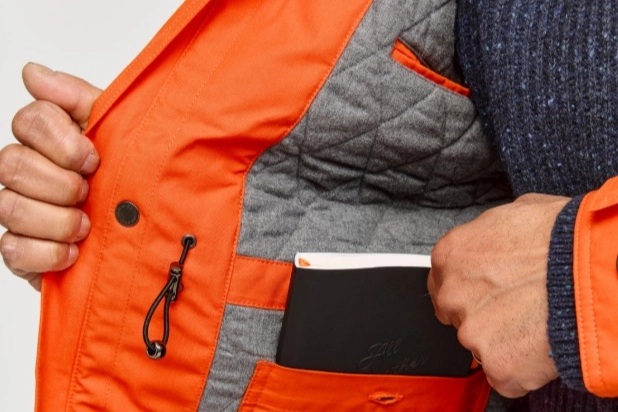
Inside pocket and quilted inner surface of a jacket
The table below summarizes how common jacket construction decisions affect fit, function, manufacturing work, and sample review.
Construction choice | Fit or functional effect | Production implication | Sample check |
Structured shoulder | Creates a defined shoulder shape | May require shoulder pads and internal support | Check shoulder balance and shape retention |
Dropped shoulder | Produces a relaxed silhouette | Requires adjusted sleeve and body proportions | Check sleeve length and arm movement |
Full lining | Covers internal construction and improves wearability | Adds lining panels and joining operations | Check lining ease and hem movement |
Added insulation | Provides thermal function and changes internal volume | Requires space for insulation and controlled placement | Check fit with intended inner layers |
Through-stitch quilting | Holds insulation in defined sections | Requires consistent stitch lines and layer alignment | Check stitch consistency and compressed areas |
Box-wall baffles | Creates separate insulation chambers | Adds internal walls, fabric pieces, and assembly work | Check chamber consistency and insulation distribution |
Welt pocket | Provides a clean integrated opening | Requires accurate positioning and opening construction | Check symmetry, corners, and pocket function |
Zippered pocket | Provides a secure pocket closure | Adds zipper preparation and attachment operations | Check zipper operation and surrounding fabric |
Construction affects manufacturing cost through the number of components, preparation steps, sewing operations, and finishing requirements involved in making the jacket.
For example, changing a patch pocket to a welt pocket is not simply a change in appearance. It changes the pocket opening construction and requires more accurate positioning and sewing. Changing an insulated jacket from sewn-through construction to box-wall baffles adds internal walls and assembly operations. The revised structure may also require adjustments to the pattern and internal space.
These changes should be reviewed with the manufacturer before the sample is finalized. A cost comparison is only meaningful when the construction details, materials, and quality requirements are clearly defined. The cost of manufacturing a jacket also depends on the wider scope of materials and production requirements.
A jacket sample should be assessed as a complete garment. Checking individual components without considering how they work together can leave problems undetected.
During sample review, pay particular attention to:
l Fit and movement: Shoulder balance, armhole position, sleeve mobility, and comfort with intended inner layers.
l Internal construction: Lining ease, insulation distribution, seam finishing, and the attachment of internal components.
l Functional details: Pocket access, zipper operation, closures, and the durability of stress points.
If a construction change is made after sample approval, the affected areas should be reviewed again. A change to insulation thickness, for example, may affect sleeve mobility and lining ease even if the outer fabric remains unchanged.
The approved sample should reflect the final construction, materials, and functional requirements rather than only the intended appearance. This is particularly important when checking a garment sample before bulk production.