 en
en  cn
cn  it
it  es
es  tr
tr  ja
ja  sv
sv  pt
pt  nl
nl  ru
ru  fr
fr  de
de  pl
pl 
Serving global fashion brands
as the core supply chain of excellence, agility, and innovation.
as the core supply chain of excellence, agility, and innovation.
02 Oct 2026 / Industry
Garment manufacturing compliance involves more than checking whether a factory holds a certificate. For apparel brands and buyers, compliance can involve factory-level requirements, product specifications, material requirements, destination-market conditions, customer requirements, and the evidence used to verify them.
The practical challenge is connecting these requirements to the actual garment order. The relevant parties need to know who provides information, who checks it, how requirements are translated into production controls, and what happens when evidence is missing, inconsistent, or no longer applicable. A structured approach to garment manufacturing compliance helps keep these responsibilities clear throughout production.
Garment manufacturing compliance refers to meeting the requirements that apply to a garment manufacturing operation and to the specific products being produced. These requirements can come from different sources and may apply at different levels.
Factory certification is only one type of compliance-related evidence. A certification may show that a defined organization, site, management system, or activity has been assessed against specified requirements within a particular scope. An audit report records findings from an assessment conducted at a particular time and within a defined scope. A test report, by comparison, normally relates to a specified material, product, property, or test method.
These documents should not be treated as interchangeable. A document can be valid while still being irrelevant to a particular order if its scope, subject, date, or applicable requirement does not match the production being reviewed.
Factory-level requirements can include applicable labour, workplace safety, and environmental obligations at the production site. These ongoing requirements are different from requirements that apply specifically to an individual garment order.
When reviewing compliance documentation, apparel brands should check:
· the relevant factory, supplier, material, or product
· the scope covered by the document
· the applicable requirement or test
· the date and reporting period
· any limitations, open findings, or conditions
· the relationship between the evidence and the actual garment order
A certification or audit report does not automatically prove that every requirement for a particular garment has been met. Similarly, a material test report does not automatically establish compliance for every finished garment.
Factory-level compliance generally relates to the production site and its ongoing activities. Order-specific requirements are more closely connected to the garment being produced and can vary according to the product, materials, destination market, intended use, production process, and customer requirements.
For example, a factory may maintain ongoing requirements covering workplace conditions or environmental practices, while a specific garment order may introduce additional material, product, testing, labeling, or customer requirements.
Customer requirements are additional requirements and do not replace applicable legal or market obligations.
Compliance Area | Typical Scope | What Needs to Be Confirmed |
Factory compliance | Production site and ongoing activities | Relevant requirements, scope, and unresolved items |
Material requirements | Fabrics, trims, and components | Applicable specifications and supporting evidence |
Product requirements | Specific garment | Applicable testing or compliance requirements |
Market requirements | Destination market and intended use | Requirements applicable to the product and market |
Customer requirements | Brand or buyer specifications | Additional requirements and responsibilities |
This distinction matters because compliance information should be assessed against the actual order rather than treated as a collection of documents that automatically covers every production situation.
Before manufacturing begins, the brand or buyer should clarify the destination market, intended product use, customer requirements, and any specific compliance conditions that apply to the order.
The relevant parties should also establish who provides information, who reviews it, who arranges testing where required, and who confirms that an issue has been resolved. Depending on the cooperation model, these responsibilities may involve the brand, manufacturer, material suppliers, testing bodies, or other designated parties.
A practical responsibility check can include:
· Who provides the applicable requirement?
· Who provides material or supplier documentation?
· Who checks whether the evidence matches the order?
· Who arranges testing or additional verification when required?
· Who confirms that an identified gap has been resolved?
· At what point must the requirement be confirmed before production proceeds?
The manufacturer may contribute production and technical information, but this does not automatically transfer all market, importer, or customer responsibilities to the factory.
Where compliance requirements affect manufacturing controls, they also need to connect with the relevant apparel manufacturing capabilities and production processes so that the agreed requirements can be implemented rather than remaining only in documentation.
Material compliance is an important part of garment manufacturing because fabrics, trims, coatings, finishes, labels, fasteners, and other components may have their own specifications and supporting documentation.
Depending on the order, relevant evidence may include material composition information, supplier documentation, restricted-substance information where applicable, test reports, declarations, or other records required by the customer or market.
The key question is not simply whether a document exists. The information should be checked against the material actually intended for the order.
Useful checks include:
· material identity
· material specification
· applicable requirement or test
· report or declaration date
· supplier information
· relationship to the actual order or batch
Having a report does not automatically mean that it can be reused for every order. Whether existing evidence remains applicable depends on what the evidence covers and whether the relevant material, specification, requirement, and production circumstances remain consistent.
Material evidence should also be distinguished from finished-product compliance. Evidence for an individual component does not necessarily establish that the completed garment meets every requirement applicable to the finished product.
Compliance information becomes useful during manufacturing when applicable requirements are translated into clear production controls.
A practical sequence is:
Requirement → Internal Instruction → Production Control → Record → Verification
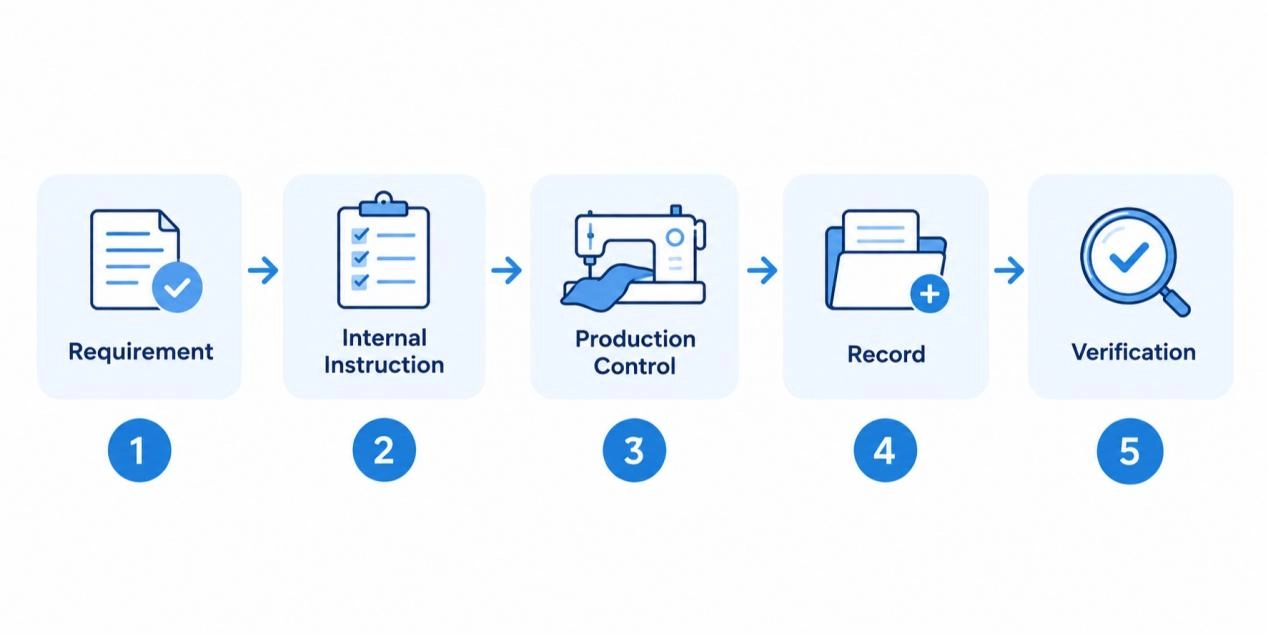
This can involve updating material information, production instructions, inspection points, approval records, or other documents used by the relevant production personnel.
Consider a hypothetical woven jacket in which a specified metal trim needs to be replaced. The first step would be to review the requirement for the original trim and the proposed replacement. The relevant party would then check the replacement material specification and supporting evidence and determine whether additional verification is needed.
If the replacement is accepted, the applicable material information and production instructions should be updated. The relevant personnel should receive the revised information, and the change should be reflected in the appropriate production records.
If the replacement affects an approved product requirement, appearance, material specification, or another agreed standard, it should not simply be treated as an internal manufacturing substitution. The potential impact should be explained and the appropriate confirmation obtained before the revised requirement is implemented.
Approved technical information should reflect any compliance-related material or construction changes so that production teams work from the current requirements. This can connect with broader apparel product development, while an apparel tech pack can provide a relevant reference for approved specifications and production communication.
Compliance verification depends on having appropriate records that can be connected to the relevant production scope.
Depending on the order, these records may include:
· material specifications and supplier information
· test reports and declarations
· approval records
· production instructions and production records
· verification results
· order and batch information
· corrective action records
· updated technical or compliance information
Traceability helps connect an actual material or production batch with its supplier, order, supporting documents, and relevant records. However, traceability itself does not establish compliance. It provides the information needed to investigate and verify whether the applicable requirement has been met.
A clear response is also needed when evidence does not support the intended production.
If evidence is missing, does not apply to the order, or shows that an applicable requirement has not been met, the affected scope should first be identified. The responsible party should then be assigned to provide the missing information, complete the necessary corrective action, or arrange further verification.
Where necessary, further use or release of the affected material, component, or product should be put on hold pending resolution. The applicable requirement should then be rechecked against the updated evidence or verification result. A designated person with the appropriate authority should confirm the disposition based on the verified outcome.
This approach helps separate an identified documentation gap from a confirmed compliance issue while ensuring that unresolved matters are not passed into later production stages without review.
Compliance requirements should not be considered permanently settled if the conditions relevant to the order change.
Potential changes can include:
· material or component changes
· supplier changes
· production process changes
· product requirement changes
· destination-market changes
· production location changes
· subcontracting arrangements, where applicable
The appropriate response depends on the nature of the change. A change should be assessed before implementation to determine whether additional confirmation, testing, documentation, or customer approval is required.
Not every production change requires full recertification or complete retesting. The relevant question is whether the change affects the requirement or evidence that supports the compliance decision.
For example, a supplier change may require a review of material identity and supporting documentation, while a change in destination market may introduce a different set of applicable requirements. The resulting review and any new evidence should be recorded so that the current production status remains clear.
For buyers managing apparel manufacturing compliance, the most useful approach is to confirm not only whether documentation exists, but also whether the documentation, responsibilities, production controls, and current order status are aligned.
Compliance Area | What to Confirm | Supporting Evidence or Status |
Factory compliance | Relevant factory requirements and unresolved items | Factory records or audit information |
Responsibilities | Who provides, checks, and confirms information | Responsible party and confirmation status |
Materials | Material requirements and supporting evidence | Material records, reports, or declarations |
Product requirements | Applicable testing or compliance requirements | Relevant evidence or current status |
Production | How requirements are communicated and controlled | Instructions and production records |
Documentation | Records supporting compliance verification | Available compliance documentation |
Traceability | Whether relevant information can be linked to the order | Available traceability information |
Changes and gaps | Whether further review is needed | Corrective action or updated status |
For manufacturers, this means maintaining a clear connection between the approved requirements and the information used during production. When a requirement changes, the updated information should reach the people responsible for implementing and checking it.
For brands and buyers, the key question is therefore not simply whether a factory can provide a certificate. It is whether the applicable requirements for the specific order have been identified, assigned to the right parties, supported by appropriate evidence, translated into production controls, and reviewed when relevant conditions change.
Garment manufacturing compliance covers the requirements and supporting evidence applicable to the factory, materials, products, production processes, and specific orders. The exact requirements depend on the product, market, customer, and applicable rules.
No. A certification or audit report applies within its defined scope. It does not automatically demonstrate that every material, product, or order-specific requirement has been satisfied.
Responsibilities arise from applicable law and agreed operational roles. The parties should clearly assign document collection, testing coordination, review, and follow-up. These arrangements do not transfer statutory obligations.
Brands should confirm the applicable market and customer requirements, responsibilities, required evidence, material and product requirements, and how those requirements will be controlled and verified during production.
The affected scope should be identified, the missing information or corrective action assigned to the appropriate party, and further use or release of affected materials or products put on hold where necessary. The requirement and evidence should then be rechecked before the next action is confirmed.