 en
en  cn
cn  it
it  es
es  tr
tr  ja
ja  sv
sv  pt
pt  nl
nl  ru
ru  fr
fr  de
de  pl
pl 
Serving global fashion brands
as the core supply chain of excellence, agility, and innovation.
as the core supply chain of excellence, agility, and innovation.
18 Sep 2026 / Industry
Garment engineering services cover technical work used to identify and resolve specific construction, component, measurement, and manufacturing feasibility issues during apparel development. The exact scope depends on the product and the technical problem being addressed.
Garment engineering is not the same as overall product development. Product development covers the broader process of turning a design concept into a manufacturable garment, while engineering focuses on specific technical problems that need to be examined, adjusted, validated, and documented.
A typical engineering issue may involve the relationship between several garment components rather than one isolated specification. A zipper may not align correctly with a front placket, for example, or a sleeve may create an unexpected construction issue when attached to the armhole.
The engineering process is therefore less about applying a fixed solution and more about understanding the problem before deciding how it should be resolved.
Engineering input can become necessary when a garment requirement creates a construction or manufacturing question that cannot be resolved simply by following the existing technical information.
The issue may become visible during sample development, construction review, or validation of a proposed manufacturing method.
A practical process can be summarized as:
Requirements and Existing Technical Information → Technical Review → Proposed Solution → Sample or Process Validation → Agreed Revisions → Updated Technical Information and Production Handover
The sequence matters because a proposed adjustment should not automatically become a production requirement. The manufacturer first needs to understand the issue, assess possible solutions, validate the relevant solution, and determine whether the result changes any approved product requirement.
Garment engineering sits within the broader apparel product development process.
Its role becomes particularly important when a technical question needs to be separated into two different issues: how a garment should be constructed and whether an adjustment would change an already approved product requirement.
For example, a manufacturer may identify a different sewing sequence that makes an approved construction easier to execute. That may be a manufacturing method clarification rather than a change to the product.
However, if the proposed adjustment changes the garment's appearance, fit, measurements, material, structure, or another agreed requirement, it should be treated as a product requirement change. The impact needs to be explained and confirmed before implementation.
This distinction keeps technical problem-solving connected to product development without allowing manufacturing decisions to silently change the approved product.
The scope of garment engineering is best understood through the technical tasks involved and the information produced from those tasks.
Technical task | Typical output |
Structure and component relationship review | Identified issue and proposed structural adjustment |
Construction and operation feasibility review | Suggested assembly sequence and key control points |
Specification conflict clarification | Revised measurement, tolerance, or construction requirement |
Technical validation | Validation result, open items, and revision record |
These outputs provide a technical basis for subsequent development and production decisions.
Garments are made from components that influence one another. A change in one area can affect another even when the individual specifications appear reasonable.
For example, the position of a front placket can influence zipper placement, facing coverage, topstitching, and the visual balance of the front panel.
An engineering review therefore considers the relationship between these elements rather than checking each measurement independently.
This type of review is particularly relevant to woven garment manufacturing, where jackets, shirts, trousers, and other structured garments can contain multiple connected construction details.
A garment can be technically specified and still raise questions about how it should be assembled.
Engineering review may examine the order in which components are joined, whether certain operations allow accurate positioning, and which points require additional control during sewing or finishing.
The objective is not simply to simplify production. It is to determine whether the proposed construction method can consistently achieve the approved garment requirements.
Technical information may sometimes contain conflicting or incomplete requirements.
A measurement may not correspond with a construction drawing. A construction note may leave room for different interpretations. A component specification may also need clarification before a sample can be developed correctly.
In these situations, engineering review helps identify the conflict and define what needs to be clarified.
If resolving the issue requires a change to an approved product requirement, that change should be clearly communicated and confirmed rather than being treated as an internal manufacturing decision.
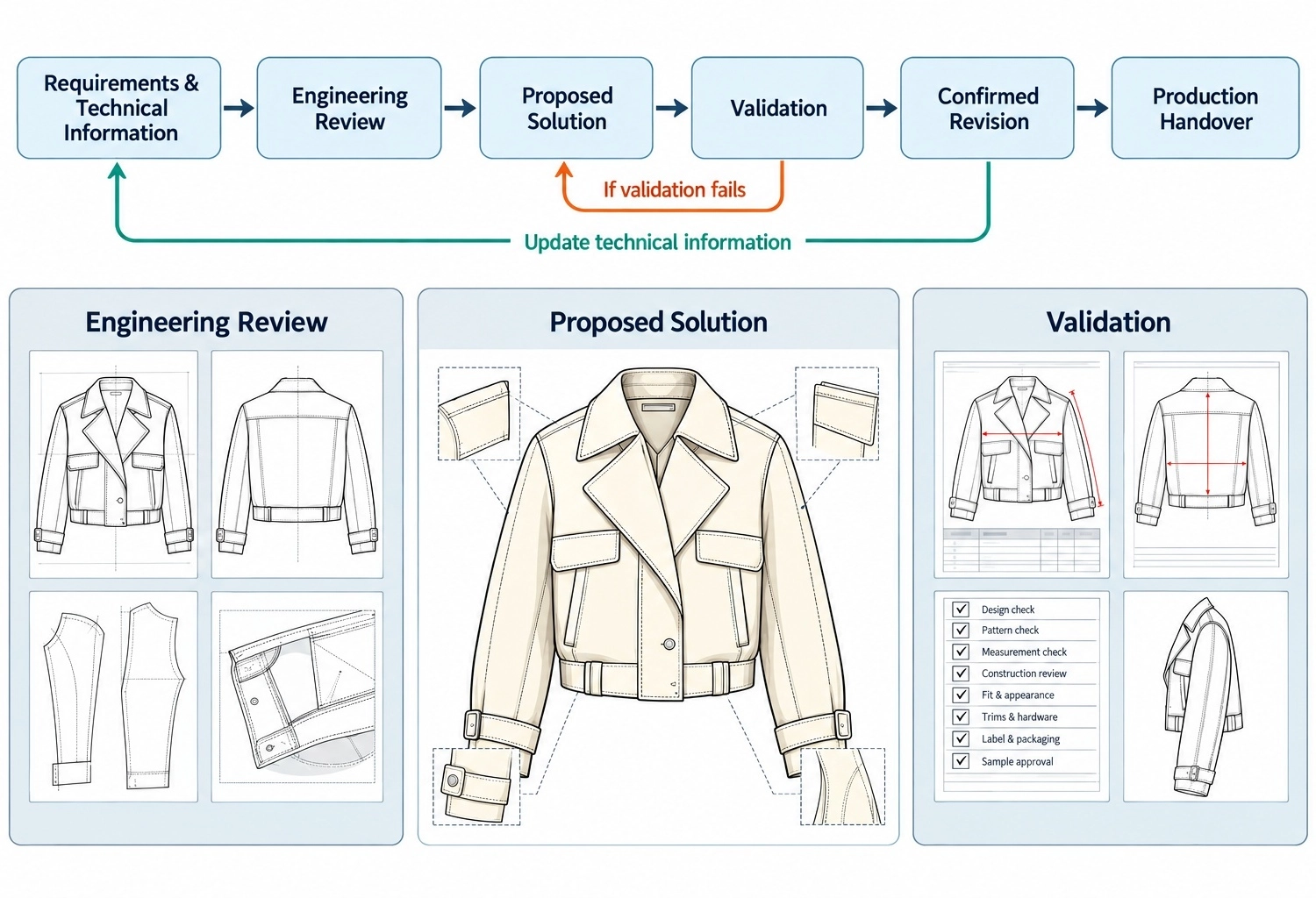
Woven garments often contain multiple connected components, which means that some technical issues cannot be fully evaluated from drawings or written specifications alone.
Practical validation becomes important when a proposed engineering solution could affect the finished appearance, construction, fit, or production method.
Consider a woven jacket where the front zipper does not align consistently with the outer placket.
The first step is not necessarily to change the pattern or move the zipper. Several factors may need to be checked:
· the positioning marks used for the zipper and placket
· the dimensions of the placket and facing
· seam allowance and component relationships
· the sewing sequence used to join the components
· the behavior of the selected material during assembly
Suppose the technical review confirms that the positioning marks for the zipper and placket do not correspond with the intended construction. A candidate adjustment could be to revise the positioning marks or clarify the relevant assembly instruction.
That proposed adjustment can then be checked through a representative sample or construction trial using the relevant materials. The validation should examine whether the zipper position, placket appearance, and surrounding structure now correspond with the approved requirements.
If the result does not meet the intended requirement, the manufacturer should continue reviewing the possible causes rather than treating the first adjustment as the final solution.
If the result does meet the requirement and the adjustment does not change an approved product specification, the revised construction information can be incorporated into the current technical reference.
If the adjustment changes an approved appearance, measurement, construction detail, or other product requirement, the manufacturer should explain the impact and obtain confirmation from the brand or its authorized technical representative before implementation.
This is a conditional example rather than a claim about a particular customer project or a universal solution. The appropriate adjustment depends on what the technical review actually identifies.
The relationship between a sleeve and armhole provides another example of why the cause needs to be investigated before a solution is selected.
If sleeve attachment produces unexpected fullness or inconsistent positioning, the review may consider sleeve shape, armhole geometry, seam allowance, notching, sewing sequence, and material behavior.
The candidate adjustment could involve one or more of these areas, but the correct response depends on the result of the technical review.
The important point is that engineering should establish the relationship between the observed problem and the proposed adjustment before the change is released.
A practical engineering review can follow five steps:
Problem → Factors to Check → Candidate Adjustment → Validation → Confirmed Result
This structure keeps the process evidence-based. It also creates a clear record of why a particular adjustment was proposed and whether the validation supported it.
Not every problem will be resolved through the same type of sample or process check. The validation method should reflect the technical issue being investigated.
A technically workable solution does not automatically become an approved product change.
The key question is whether the adjustment only clarifies how an existing requirement should be manufactured or whether it changes the approved product itself.
A proposed adjustment may need to be evaluated against several aspects of the garment, including:
· appearance and visual balance
· fit and finished measurements
· material and component compatibility
· construction method
· sewing or assembly sequence
· tolerances and quality requirements
· consistency during production
A solution that resolves one technical issue but creates another should not be treated as a completed engineering result.
The review should therefore consider the affected construction as a whole rather than evaluating only the immediate problem.
Validation may involve a physical sample, construction trial, or another appropriate technical check.
The purpose is to determine whether the candidate solution actually produces the intended result under relevant conditions.
For example, in the zipper and placket case, the validation should not focus only on whether the zipper has moved into the correct position. The surrounding placket appearance and construction relationship also need to be considered.
The same principle applies to sleeve and armhole construction. A change that improves one measurement may still create an unwanted effect elsewhere in the garment.
If the proposed adjustment affects an approved product requirement, the manufacturer should explain the impact and obtain confirmation from the brand or its authorized technical representative before implementation.
Once the change is confirmed, the relevant specifications, sample references, construction information, and revision records should be updated to reflect the agreed requirement.
This distinction is important because technical feasibility and product approval are not the same decision.
A manufacturer may determine that a particular construction is technically possible, but that does not by itself authorize a change to an approved product.
Engineering work needs to result in clear technical information that can be understood by the people responsible for subsequent development or production.
Drawings, measurements, construction details, component specifications, sample references, and other technical information establish the current product requirements.
An apparel tech pack can provide an important reference for this information, particularly when measurements, materials, construction details, and revisions need to be communicated consistently.
However, the technical information is not necessarily final simply because it already exists. Engineering review may identify a conflict, unclear requirement, or construction issue that requires clarification.
The technical information therefore acts as the starting reference for engineering rather than as a document that can never be changed.
When a solution has been validated and, where necessary, approved by the brand or its authorized technical representative, the relevant technical information should be updated.
Depending on the issue, this may involve:
· measurements or tolerances
· construction details
· component positioning
· operation sequence
· technical notes
· sample references
· revision records
The purpose is to ensure that the current production reference reflects the latest confirmed requirement.
The main documentation objective is straightforward: the technical information used for the next stage should match the latest confirmed decision.
There is no need to repeat the entire engineering process in every document. What matters is that the confirmed adjustment, its applicable scope, and any relevant validation result are clear enough for the next team to work from the correct information.
Engineering readiness does not mean that every production variable has been resolved. Material availability, order status, scheduling, and other manufacturing conditions still influence when production can begin.
The engineering question is narrower: are the relevant technical requirements sufficiently clear, validated, and confirmed for production handover?
Key technical issues affecting production should be resolved, with the necessary validation completed, before technical release. Any remaining items should be confirmed as non-blocking, with an agreed owner and closure plan.
This creates a practical boundary between technical readiness and the wider conditions required to launch production.
Before handover, the validated result should correspond with the latest agreed technical information.
This is particularly important when several revisions have taken place. A physical sample may represent an earlier version, while a later revision may contain a different measurement or construction requirement.
The production reference therefore needs to reflect the latest confirmed decision rather than simply the most recently created document.
A clear handover should establish which technical information applies to production and which previous versions are no longer current.
The relevant construction requirements, confirmed changes, and applicable validation results should be available to the production team in a form that can be followed without relying on informal assumptions.
At KINGSRICH, garment development is connected with manufacturing, helping confirmed technical requirements move from development into production.
Garment engineering services cover technical work related to construction, component relationships, specifications, manufacturing feasibility, validation, and the documentation of confirmed technical adjustments.
Product development covers the broader process of developing a garment, while garment engineering focuses on specific technical and construction problems that arise within that process.
Not every manufacturing clarification changes an approved product requirement. However, if a proposed adjustment affects an approved requirement such as appearance, fit, measurement, material, structure, or construction, the manufacturer should explain the impact and obtain confirmation from the brand or its authorized technical representative before implementation.
Not necessarily. The appropriate validation method depends on the technical issue. Some matters can be clarified through technical review or process checks, while others require a physical sample or construction trial.