en
 cn
 it
 es
 tr
 ja
 sv
 pt
 nl
 ru
 fr
 de
 pl

Serving global fashion brands
as the core supply chain of excellence, agility, and innovation.
as the core supply chain of excellence, agility, and innovation.
25 Oct 2026 / Industry
The main difference between knitted and woven garments lies in how their fabrics are constructed. Knitted fabrics are formed by interlooping yarns, while woven fabrics are made by interlacing lengthwise warp yarns with crosswise weft yarns. These different structures influence how a fabric stretches, drapes, retains its shape, and behaves during garment manufacturing.
However, construction alone does not determine every fabric property. Fiber composition, yarn characteristics, fabric weight, density, and finishing treatments also affect performance. Understanding these factors helps apparel brands select suitable materials for their product requirements.
For buyers comparing knitted and woven garments, the decision should go beyond appearance. Fabric performance, garment fit, intended use, and production requirements all need to be considered before confirming a material.
Knitted and woven fabrics often behave differently, but neither construction is universally better. Actual performance depends on the specific fabric and how it is made.
Comparison Factor | Typical Behavior | Conditions Affecting Behavior |
Stretch | Knitted fabrics often offer more structural stretch than conventional woven fabrics. | Knit structure, yarn properties, elastane content, fabric density, and finishing. Stretch woven fabrics are also available. |
Recovery | Recovery describes how well fabric returns toward its original dimensions after stretching. | Fiber and yarn properties, construction, elastane content, and finishing. High stretch does not necessarily mean good recovery. |
Drape | Both knitted and woven fabrics can have soft or structured drape. | Fabric weight, stiffness, yarn characteristics, construction, and finishing. |
Comfort and breathability | Either construction can provide suitable comfort and airflow for a particular application. | Fiber composition, porosity, fabric weight, moisture management, and finishing. |
Wrinkle behavior | Neither construction guarantees better wrinkle resistance. | Fiber properties, yarn structure, fabric construction, finishing, and care conditions. |
Dimensional stability | Fabrics may shrink, stretch, or distort under certain conditions. | Fiber type, yarn, construction, finishing, washing, and processing conditions. |
Edge behavior | Some knits may curl or develop runs, while woven fabrics commonly fray at cut edges. | Specific knit or weave structure, yarns, finishing, and edge treatment. |
One important distinction is the difference between stretch and recovery. Stretch measures how much a fabric can extend under an applied force, while recovery describes how well it returns toward its original dimensions after that force is removed. A fabric may stretch easily but retain unwanted deformation.
Fabric drape and comfort also depend on more than construction. A lightweight woven fabric may drape softly, while a dense knitted fabric may provide substantial support. Buyers should evaluate the actual material against the intended garment specifications rather than rely on general assumptions about knit or woven fabric.
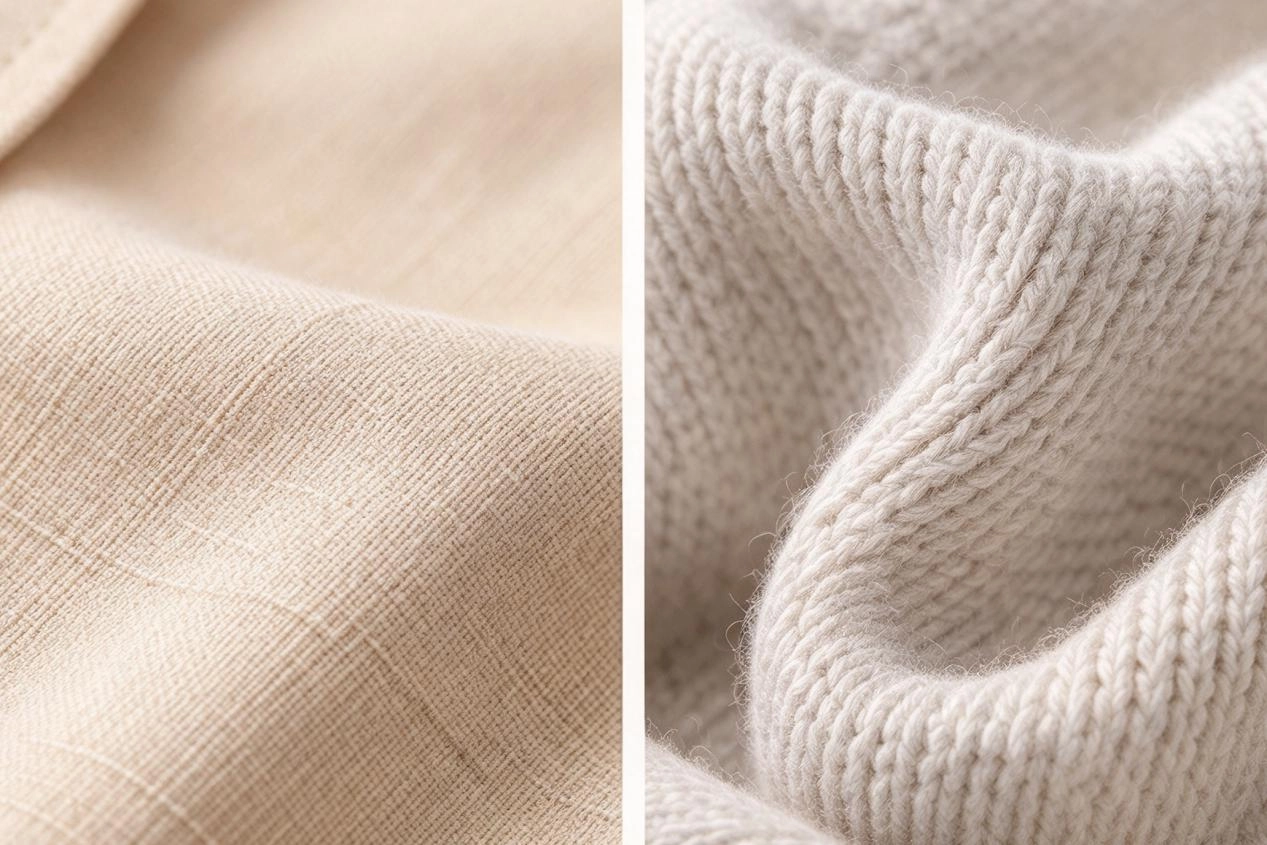
Knitted fabrics are commonly used for T-shirts, sweatshirts, hoodies, leggings, and other garments designed around softness, stretch, or freedom of movement. Their looped construction can provide useful flexibility, although the amount of stretch varies between fabrics.
Woven fabrics are widely used for shirts, blouses, trousers, denim garments, and tailored jackets. Depending on their construction and finishing, they can provide the stability, shape retention, or structured appearance required by many apparel designs.
These are typical applications, not exclusive categories. Some knitted fabrics are designed for structure, and some woven fabrics incorporate stretch. Garments may also combine knitted and woven components to meet different functional or aesthetic requirements.
The appropriate choice depends on the intended silhouette, fit, movement, appearance, care requirements, and fabric performance. Apparel brands should define these requirements before choosing a fabric construction.
This section focuses on cut-and-sewn garments made from knitted or woven fabrics. Fully fashioned and other shaped-knit production routes follow different processes and are outside this comparison.
For cut-and-sewn garments, fabric construction can influence several stages of production.
Spreading: Fabric stability, stretch, relaxation, and handling requirements can affect preparation before cutting. Some fabrics need appropriate relaxation or handling procedures to reduce the risk of dimensional changes during production.
Cutting: Fabric behavior influences pattern placement, cutting accuracy, and marker planning. Grainline, fabric direction, dimensional stability, and the arrangement of pattern pieces must be considered alongside usable fabric width.
Sewing: Seam construction, stitch selection, fabric handling, and seam extensibility should match the material and garment design. A seam suitable for a stable woven fabric may not perform the same way on a stretchy knit, while some stretch woven fabrics also require specific construction considerations.
Finishing and inspection: Garments should be checked against the applicable specifications for appearance, measurements, and dimensional stability. The required checks depend on the material, product design, and intended use.
These considerations are especially important in woven garment manufacturing, where fabric behavior, pattern requirements, and construction details must work together to achieve consistent results.
Fabric selection should begin with the product's intended use and performance requirements, rather than a blanket preference for one construction.
Before making a decision, apparel teams should consider:
l Silhouette and structure: Determine whether the garment requires a relaxed shape, a close fit, or a more structured appearance.
l Stretch and recovery: Assess the movement required during wear and whether the fabric can maintain its intended fit after repeated stretching.
l Drape and hand feel: Evaluate how the material hangs, feels against the skin, and supports the desired appearance.
l Dimensional stability: Consider shrinkage, distortion, and care requirements under the relevant conditions.
l Construction requirements: Check openings, seams, closures, and other garment details against the selected fabric.
l Material specifications: Review fiber composition, weight, density, and finishing.
For example, when a garment design changes from knitted fabric to woven fabric, the original pattern should not automatically be reused. Apparel teams need to reassess wearing ease, openings, and seam extensibility, then validate the changes through sample evaluation. Even if the overall silhouette remains similar, differences in fabric behavior can affect fit and construction.
A structured approach to fabric selection helps brands align material properties with product requirements before bulk production begins.
Before approving a fabric for production, buyers and product development teams should confirm the following:
l Fabric construction and fiber composition.
l Fabric weight and relevant finishing details.
l Stretch and recovery requirements, where applicable.
l Dimensional stability and shrinkage under defined test conditions.
l Pattern measurements, garment openings, and seam requirements.
l Whether the fabric has been evaluated against the intended garment specifications.
These checks should form part of apparel product development.
Where sample evaluation is required, garment sample approval helps teams confirm that the selected material and construction meet the agreed requirements.
Ultimately, the differences between knitted and woven garments begin with fabric structure, but successful material selection requires a broader assessment. By considering performance, fit, construction, and production requirements together, apparel brands can make more informed decisions and reduce the risk of material-related problems during manufacturing.